

1. What materials are used in your cable management products?
Our cable management range is manufactured from high-performance materials including:
- Polyamide (Nylon 6/6): High mechanical strength, flame-retardant (UL94 V-2 or V-0).
- Polyethylene (PE) / Polypropylene (PP): Good flexibility, chemical resistance.
- PVC: Economical with good insulation properties.
- Silicone-coated Fiberglass: Excellent heat and flame resistance.
- Stainless Steel (AISI 304 / 316): Corrosion-resistant for demanding environments.
2. What temperature ranges do your cable accessories withstand?
Typical operating temperature ranges:
- Standard Nylon products: –40°C to +100°C
- Heat-stabilized Nylon: up to +120°C
- Fiberglass Sleeves: up to +180°C continuous (4000 volts)
- Silicone Fire Protection Sleeves: –40°C to +600°C (short-term up to +1200°C)
- Stainless Steel Cable Ties: –80°C to +120°C
3. Are the cable glands waterproof or dustproof?
Yes. Our cable glands are rated IP65, IP66, IP67, and IP68 depending on the model. They provide:
- Strain relief
- Vibration resistance
- Sealing against dust, water, and oil ingress
Tested according to EN 60529 and DIN standards.
4. What standards and certifications do your products comply with?
UL and CSA for flame retardancy and performance
- RoHS / REACH for environmental compliance
- IEC 62444 (Cable glands)
- DIN 5510 / BS 6853 (Fire safety – transit systems)
- ISO 9001:2015 (Quality management)
5. What is the tensile strength of your cable ties?
Depending on type and size:
- Standard Nylon ties: 80–120 N
- Heavy-duty ties: up to 540 N
- Stainless steel ties: up to 890 N
All tested to EN 50146 and MIL-SPEC standards.
6. How are spiral wraps and spiral guards sized?
They are specified by:
- Inner Diameter (ID): typically, 9mm–128 mm
- Wall Thickness: 1.5–6 mm
- Pitch / Spiral Gap: defines flexibility and bundle capacity
Material options include HDPE, LDPE and flame-retardant grades.
7. What are the fire protection properties of your sleeves?
- Fiberglass Sleeves: Withstand continuous temperatures up to 600°C.
- Silicone Fire Sleeves: Provide flame protection up to 1200°C for short duration’s.
- Compliant with: EN 45545-2 (railway) and UL1441 VW-1 (flame test).
8. How do you select the correct cable gland size?
Match the cable outer diameter (OD) to the gland’s clamping range.
Example:
| Gland Size | Clamping Range | Thread Type |
| M16 | 5–10 mm | Metric / PG / NPT |
| M20 | 6–12 mm | Metric / PG / NPT |
| M25 | 9–17 mm | Metric / PG / NPT |
Always verify environmental sealing and thread compatibility.
9. What are the mechanical properties of your fasteners and clamps?
- Pull-out strength: 50–150 N (depending on size/material)
- Impact resistance: –20°C to +50°C (for polyamide)
- Corrosion resistance: up to 72 hours in salt spray test (for coated metal clamps)
10. What chemical resistance do your plastic accessories offer?
Our nylon and polypropylene accessories resist oils, fuels, alkalis, and most solvents.
Avoid prolonged exposure to strong acids or phenolic compounds unless specified as chemical-grade material.
11. Can adhesive mounts withstand high temperatures or moisture?
Yes. Adhesive bases use industrial-grade acrylic or rubber-based adhesives, rated:
- Temperature: –20°C to +90°C (standard), up to +120°C (high-temp)
- Shear Strength: >30 N/cm²
Surface must be clean, dry, and oil-free before mounting.
12. How do I calculate the correct duct size for cable routing?
Use the 40% fill rule:
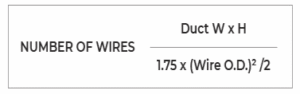
This ensures efficient ventilation and simplifies future cable additions.
Ducts are available with or without slotted walls for easy cable exit.
13. What are the dielectric properties of fiberglass and silicone sleeves?
- Dielectric Strength: 1.5–10 kV/mm
- Insulation Class: H or C (up to 200°C and 220°C respectively)
Ideal for motor windings, transformers, and high-voltage cables.
14. What is the difference between textile sleeves and spiral wraps?
- Textile Sleeves: Braided or woven, self-closing or expandable, suitable for high flexibility and abrasion resistance.
- Spiral Wraps: Helical plastic design for easy cable insertion/removal and re-routing.
15. Can I order custom lengths, diameters, or colors?
Yes. Customization options include:
- Length: Cut-to-size
- Diameter: 3–100 mm depending on product
- Colors: Black, grey, red, blue, transparent, or per RAL specification
- Branding: Logo or part number printing available on request
16. Do you offer data sheets and CAD files for engineers?
Yes. 2D drawings, 3D CAD models, and technical data sheets (PDF/DWG/STEP) are available for download or by request through our technical support team.
17. What is the shelf life and storage recommendation for plastic accessories?
- Shelf Life: 3–5 years (in sealed packaging)
- Storage Conditions: 10–25°C, <70% humidity, away from UV light and direct heat sources.
18. How are rivets and spacers typically installed?
- Rivets: Installed using manual or pneumatic rivet guns. Available in push-in, blind, and snap-fit types.
- Spacers: Used to separate panels or PCBs, made from nylon, PVC, or metal; available as threaded or snap-in types.